Designing an AI-native operating system for modern dental clinics.
Remedico is a cloud-based Dental EMR that brings scheduling, medical records, treatment planning, billing, patient communication, AI features, and government integrations into a single system.
I joined as the founding designer in 2022, when the team was three people and a blank Figma file. Over four years, my role evolved from creating the first wireframes to designing the product ecosystem, growing the brand, and implementing an AI-first approach to product delivery.
“In healthcare, great UX doesn't just save seconds — it protects clinicians' attention.”
Role
Founding Product Designer
Period
April 2022 – June 2026
Markets
UAE · MENA · UK
Type
B2B SaaS · Dental EMR
Scope
30+ modules, brand, AI workflows, frontend
Context
From empty canvas to clinic operating layer.
Remedico is not a booking app or a lightweight CRM. It sits at the center of a clinic's daily operations — appointments, patients, treatment plans, charting, payments, documents, communications, online booking, and clinical decision-making.
My role expanded with the product: first brand and interface, then UX architecture, then clinical workflow design, then AI-assisted product development and frontend implementation.
The work became less about designing screens and more about designing how a clinic thinks, moves, communicates, and makes decisions.
The challenge
Dental software has to be clinically accurate, operationally fast, and trusted under pressure.
Before designing the product, I had to learn dentistry from the ground up — tooth anatomy, periodontal workflows, paper charting protocols, baseline conditions, and how dentists actually move through an appointment.
01
Clinical precision
Doctors need charting, diagnoses, perio measurements, and treatment plans to reflect real clinical logic — not generic SaaS patterns.
02
Operational complexity
Front desk teams manage calendars, bookings, confirmations, payments, patient communication, and last-minute changes at speed.
03
Regulatory trust
The UX had to support clinical compliance expectations including NABIDH and ICD-10 alignment while remaining usable in everyday clinic work.
04
Grounded in real workflows
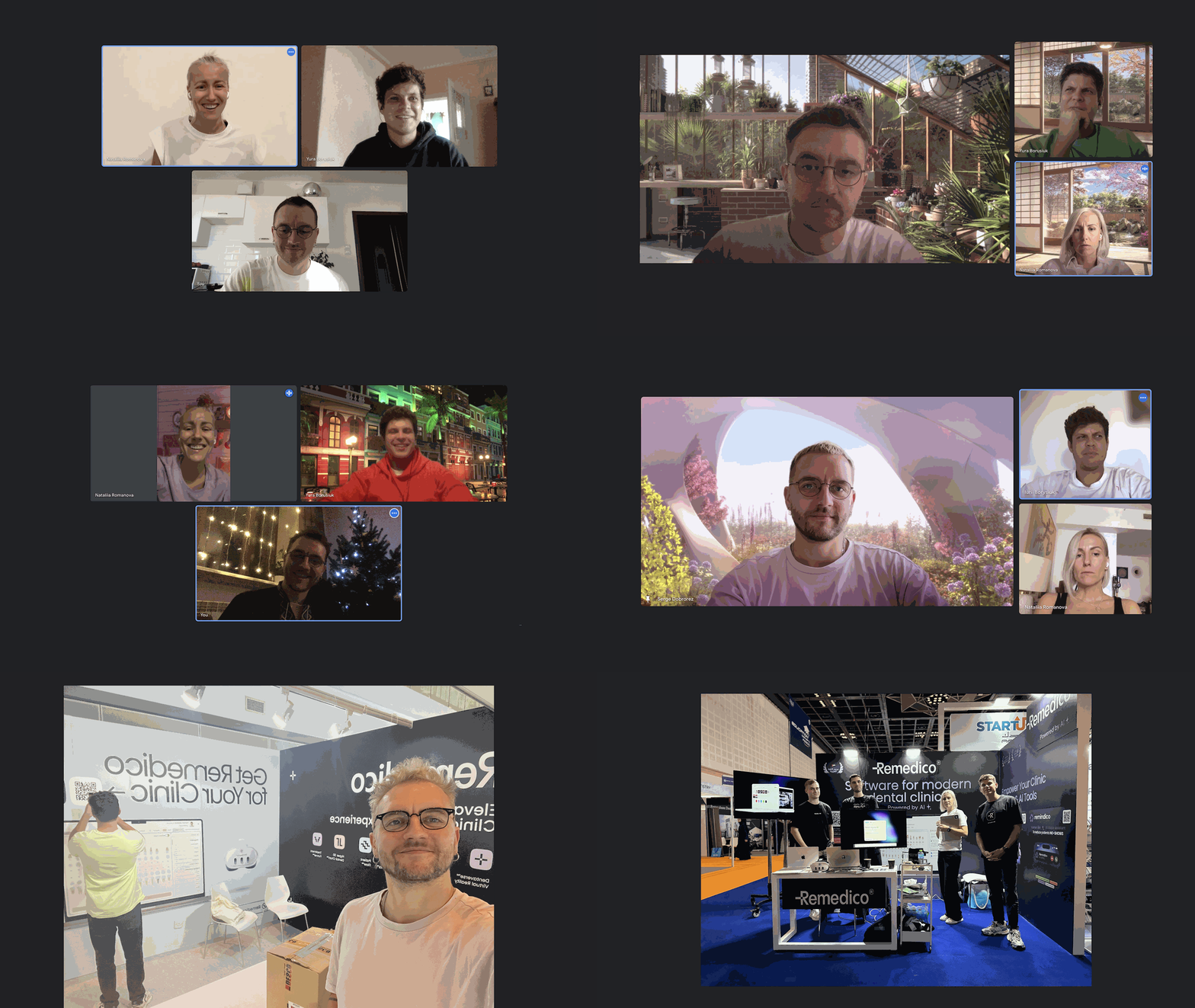
A critical step was interviewing dentists and front-desk teams and observing how clinics actually operate day to day — so the product reflected real practice, not assumptions.
Design principles
Six constraints that shaped every decision.
01
Reduce cognitive load
Surface only what the clinician needs at this moment. Irrelevant context is noise.
02
Surface critical information first
Allergies, medical alerts, and critical health conditions must be visible upfront — anything that can affect the course of treatment should never be buried in the details.
03
Minimize clicks
The fastest path should be the obvious one. Remove confirmation dialogs for reversible actions.
04
Design for fast decision-making
Clinicians move quickly. The interface must move with them, not against them.
05
Consistency across modules
Same patterns for same actions. The calendar, chart, and treatment plan speak the same language.
06
Simplify without losing context
Complex clinical data compressed into clear surfaces — without hiding the nuance that matters.
Product architecture
A system of connected clinic workflows — not isolated features.
The biggest product design challenge was connecting modules that usually live separately: calendar, online booking, treatment planning, charting, patient records, communications, and AI assistance.
01
Calendar
Appointments, chair time, doctors, statuses, confirmations, conflicts.
02
Online Booking
Patient requests flow into the clinic calendar for approval and scheduling.
03
Treatment Plans
Diagnoses, procedures, phases, healing periods, and booking actions.
04
Dental Chart
Tooth-level diagnoses, procedures, voice input, and clinical context.
05
Communication Hub
WhatsApp, SMS, email templates, triggers, reminders, confirmations.
06
AI Assistant
Voice-driven diagnosis, perio guidance, agentic workflows, clinical support.
Calendar
The calendar became the operational command center.
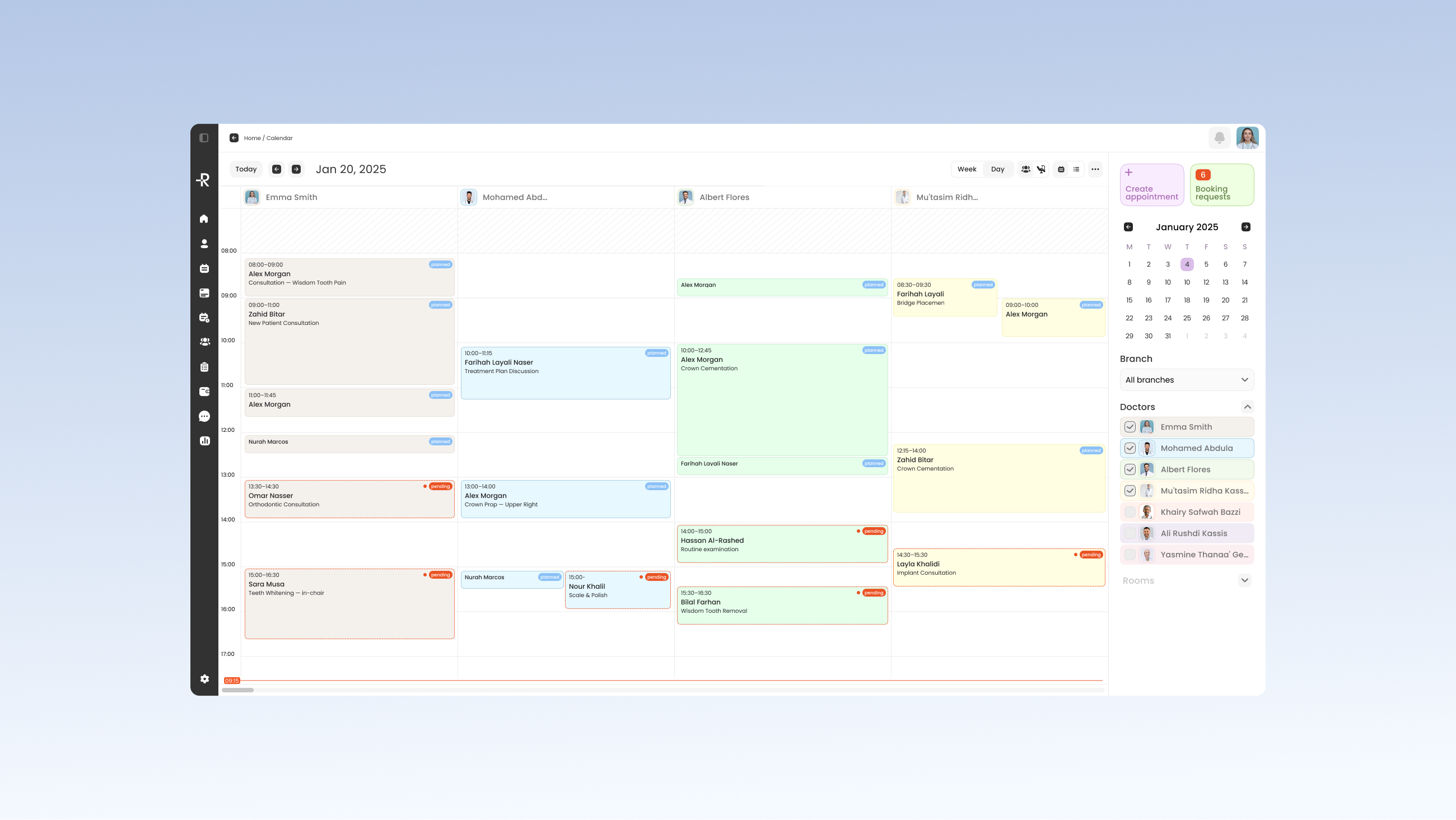
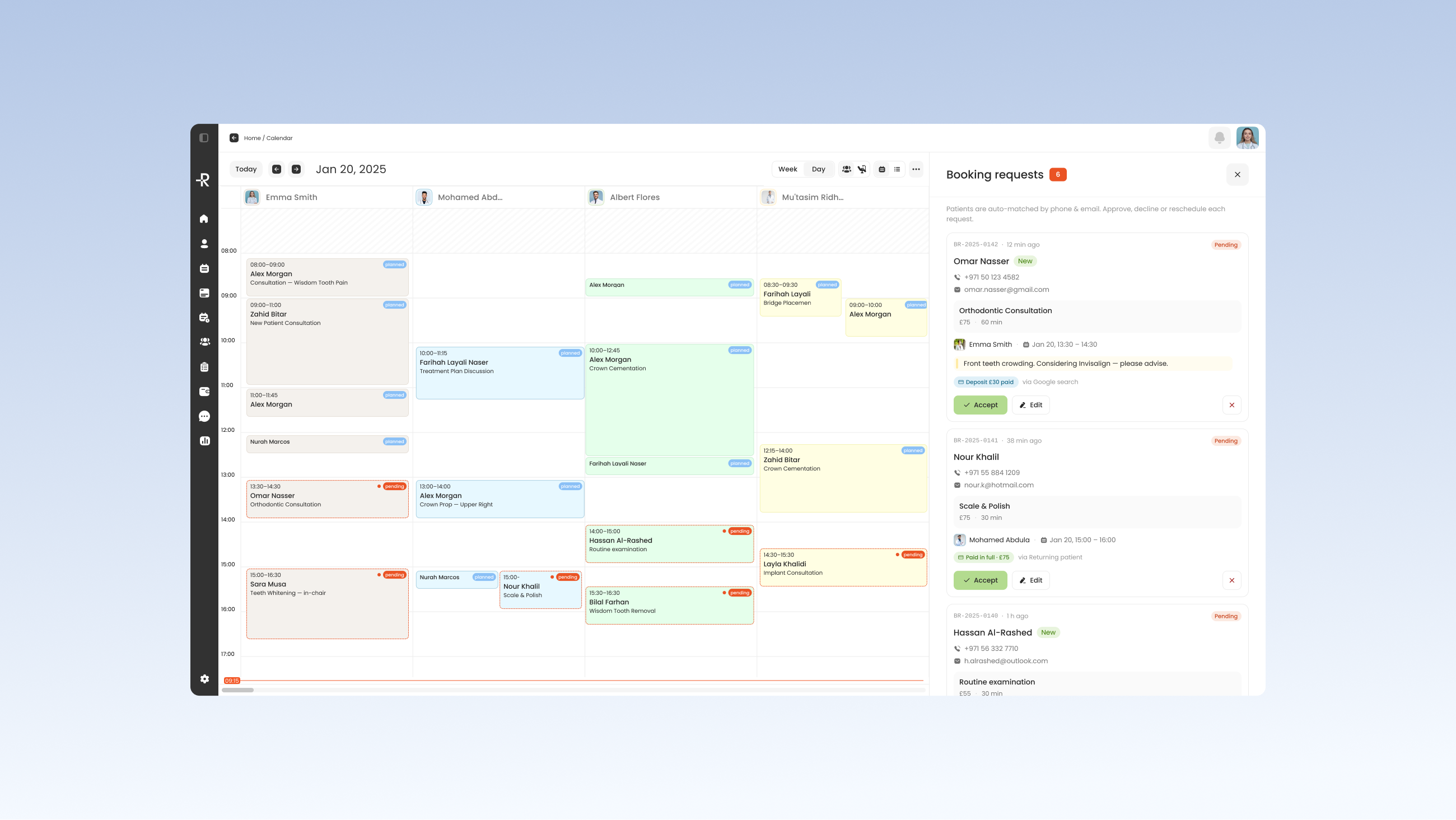
For dental clinics, the calendar is not just a schedule. It is the live map of clinic capacity, doctor availability, chair time, patient flow, appointment statuses, cancellations, and revenue opportunities.
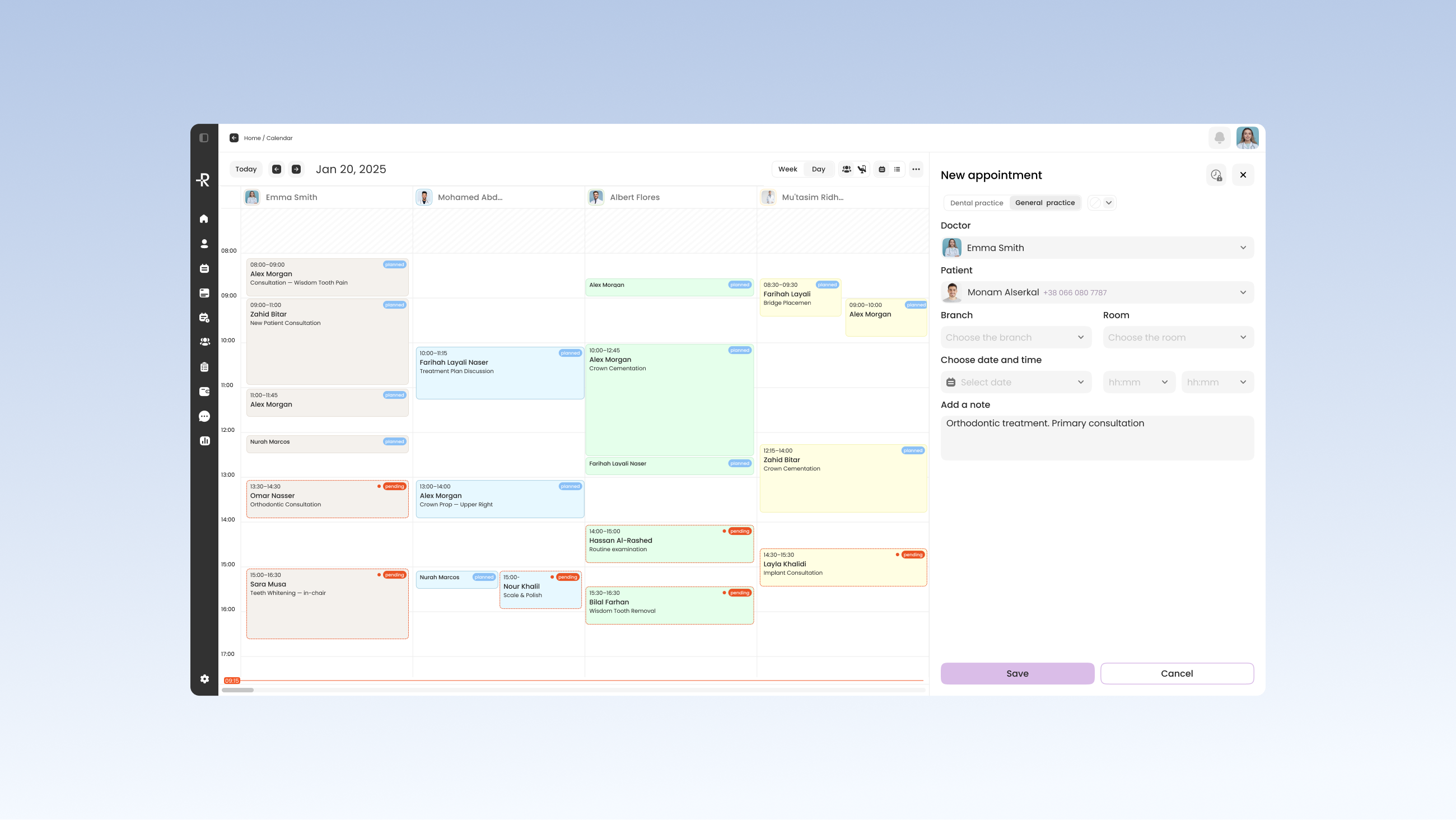
I designed calendar workflows that support clinic teams throughout the day — from creating appointments and managing statuses to handling booking requests and connecting appointments with treatment plans.
Overview
Week view — doctors as columns, statuses, chair time, and the day at a glance.
Online booking
Online booking had to feel simple for patients — but operationally safe for clinics.
I designed an online booking flow integrated directly with the clinic calendar. Patients can request appointments through a clean booking experience, while clinic teams keep control over approval, availability, doctor assignment, and schedule changes.
I didn't reinvent the wheel here — I leaned on the proven booking patterns established by Booksy and Fresha, then adapted them to the clinical and operational constraints of a dental EMR.
The key was balancing conversion with operational reality: patients need speed, but clinics need accuracy.
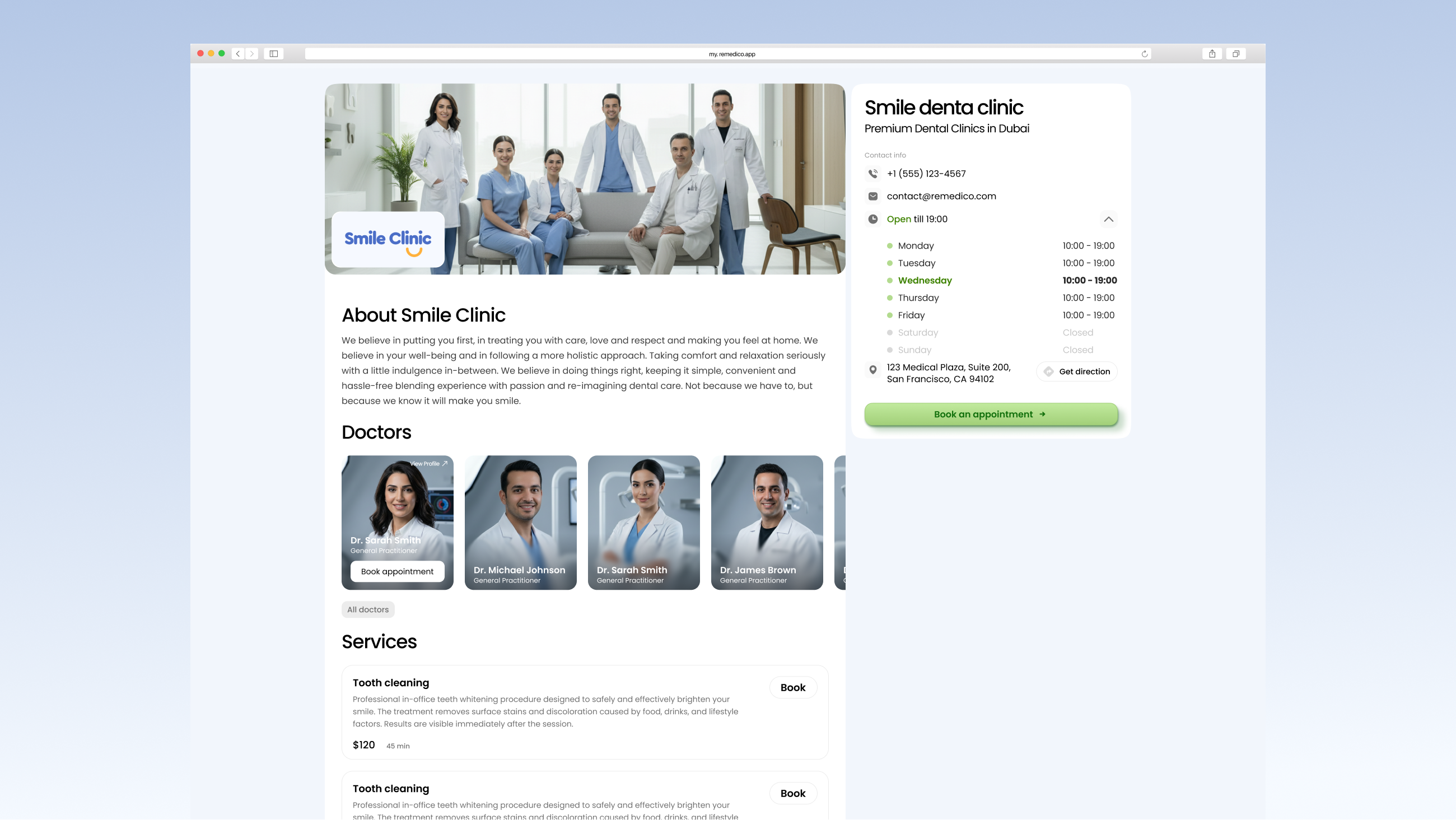
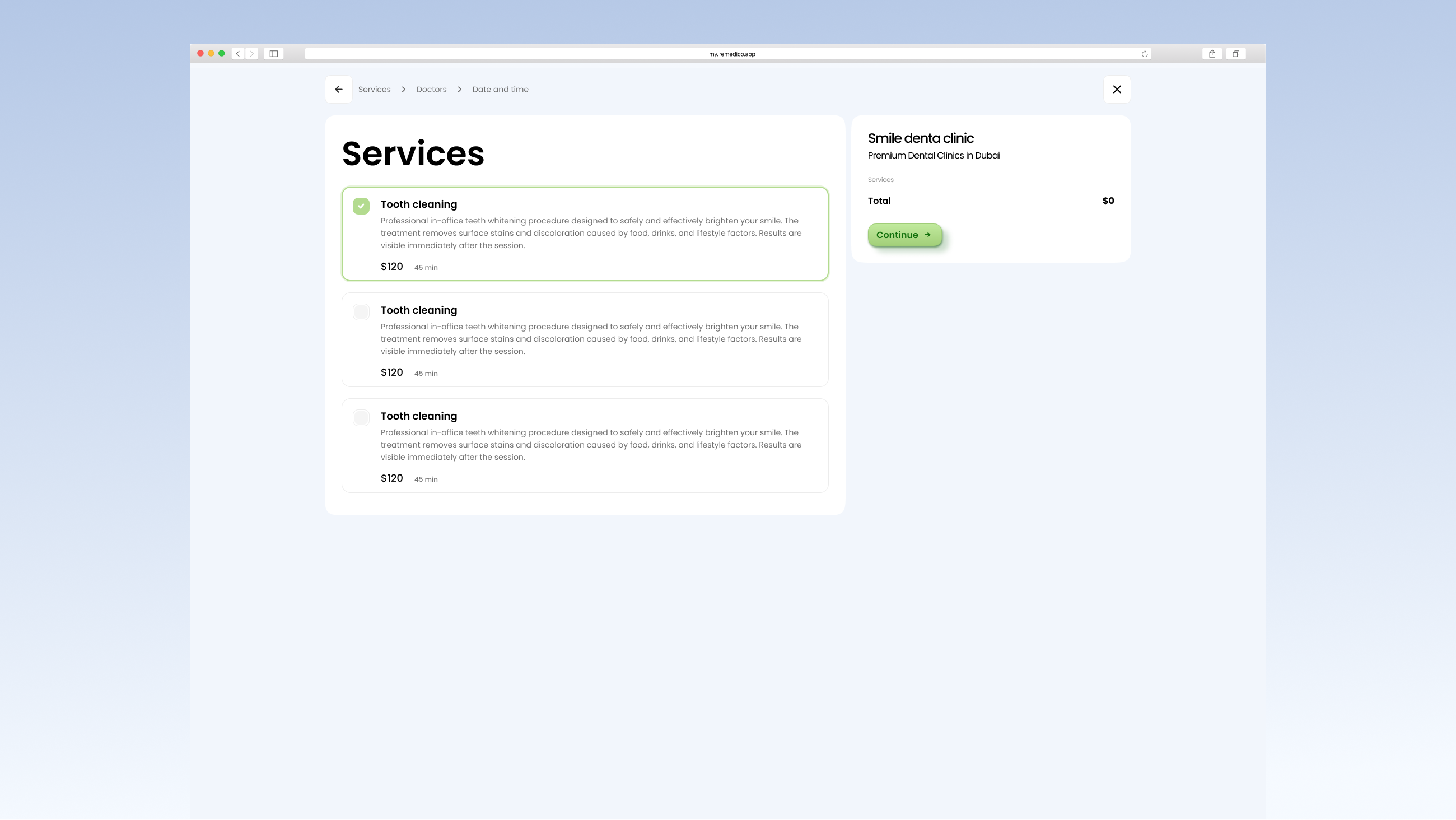
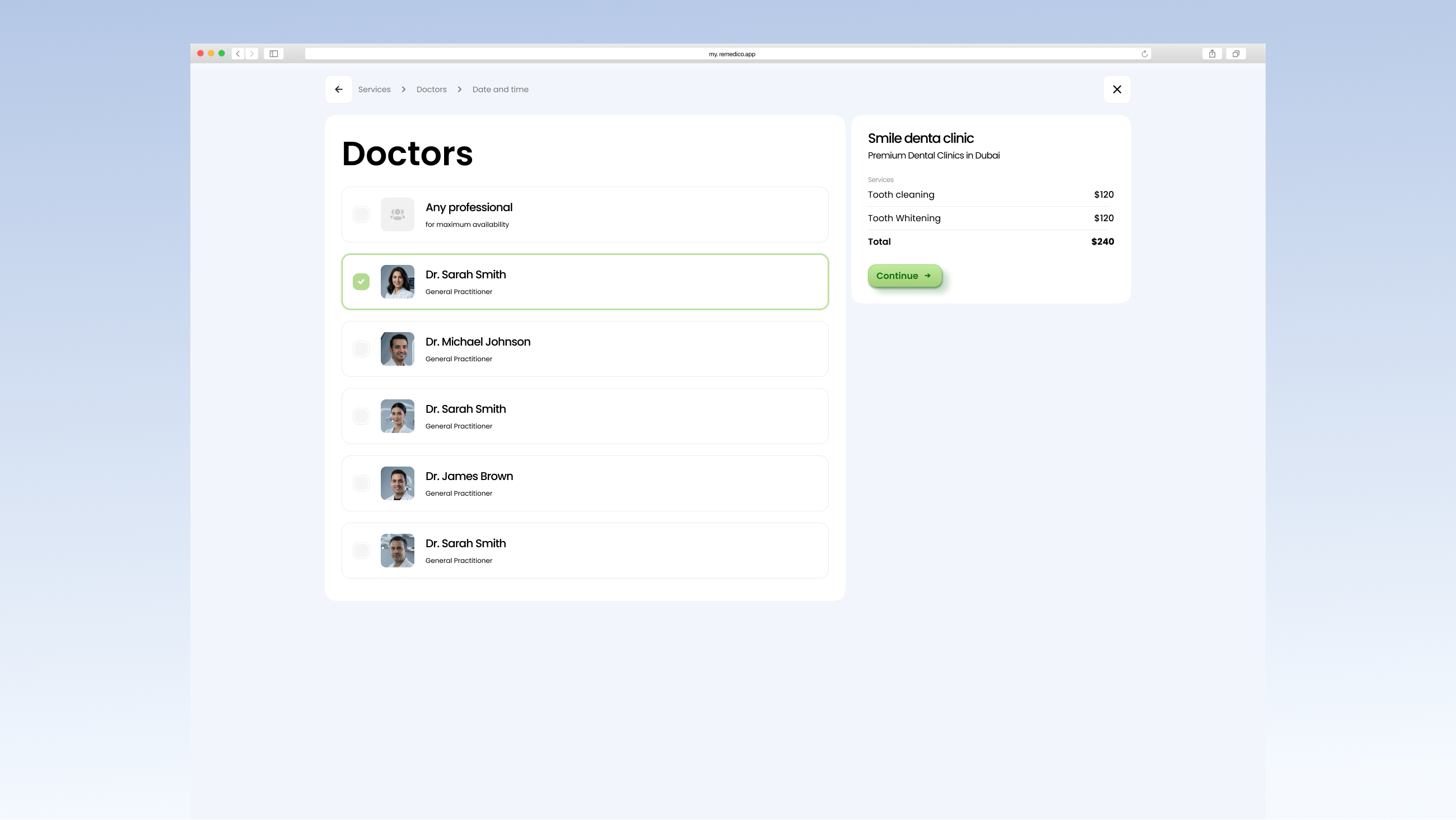
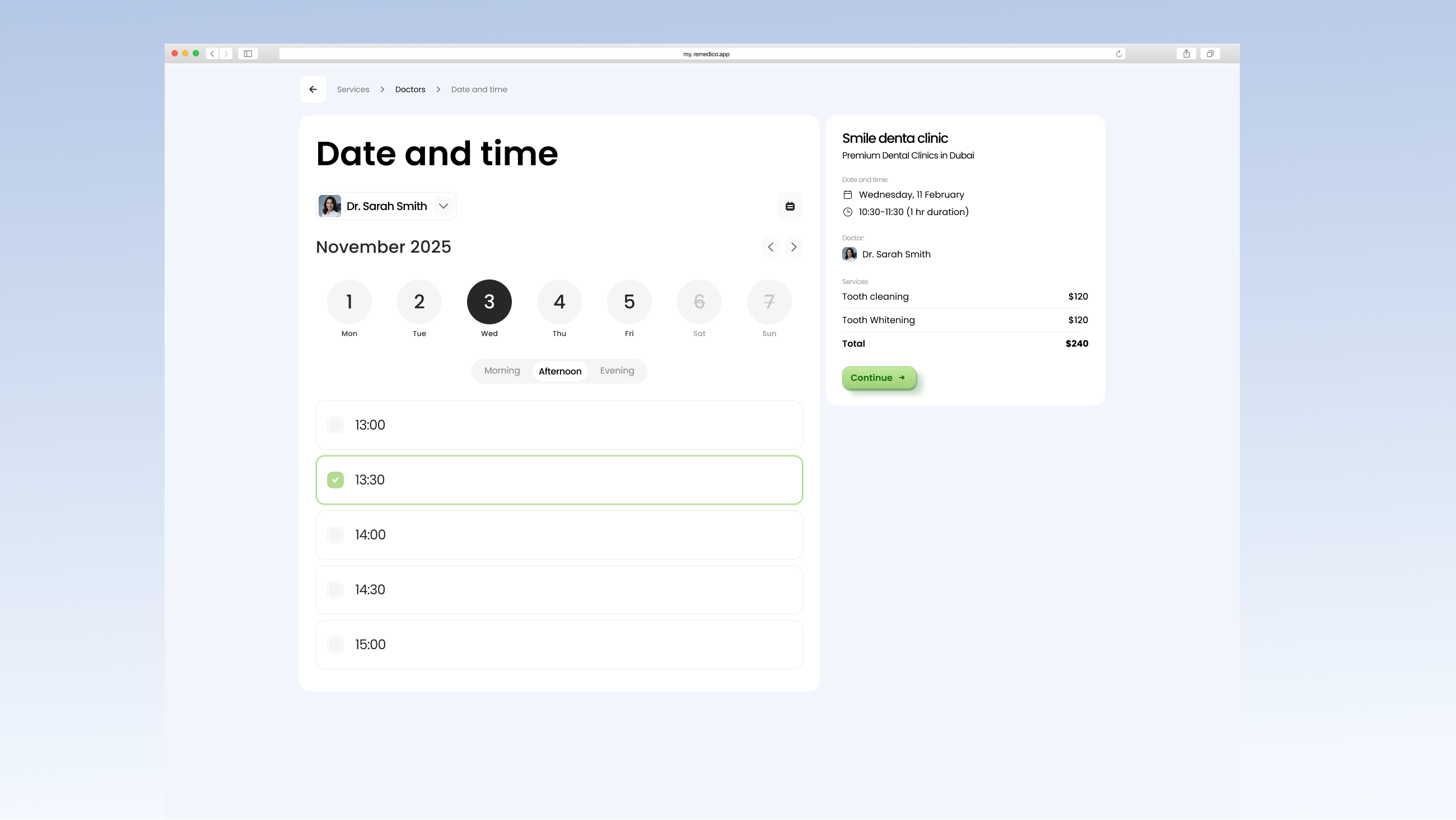
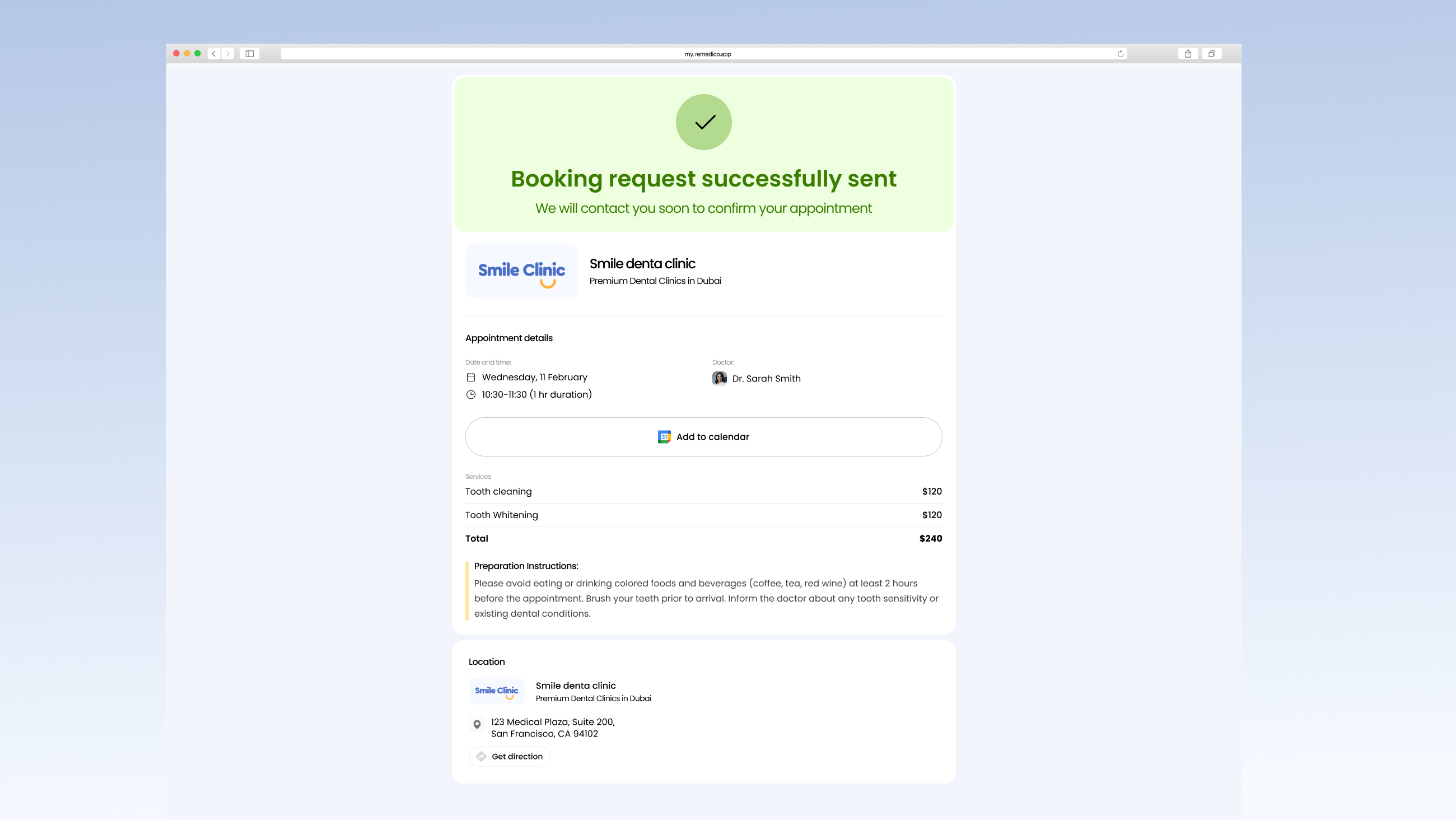
Step 1 · Landing
A clean entry point that gets patients into the flow fast.
Dental chart
Designing a chart dentists could trust.
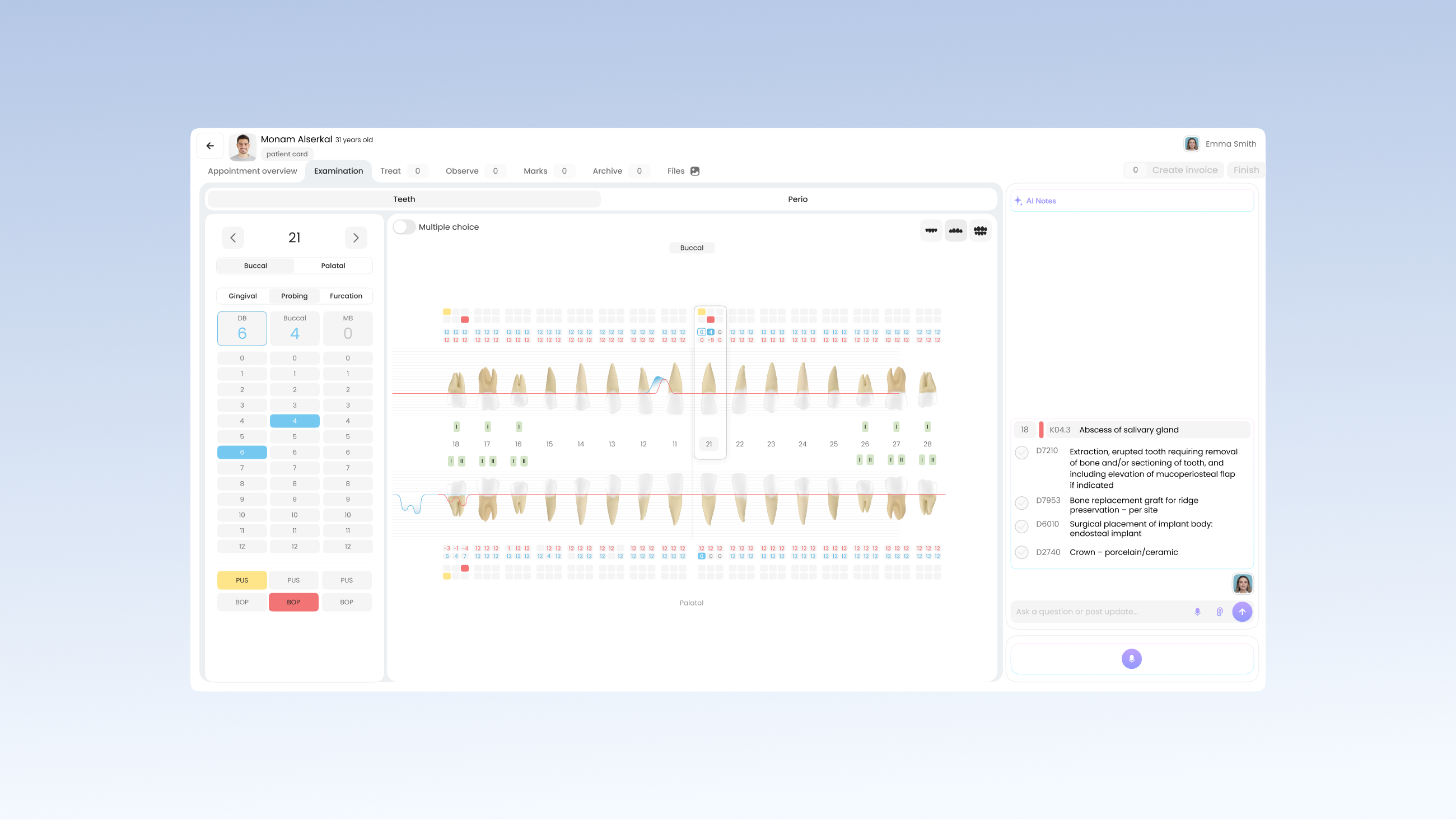
The dental chart was one of the foundational systems. I designed it as an SVG overlay mapped against real tooth anatomy, allowing diagnoses and procedures to be attached to specific teeth and surfaces.
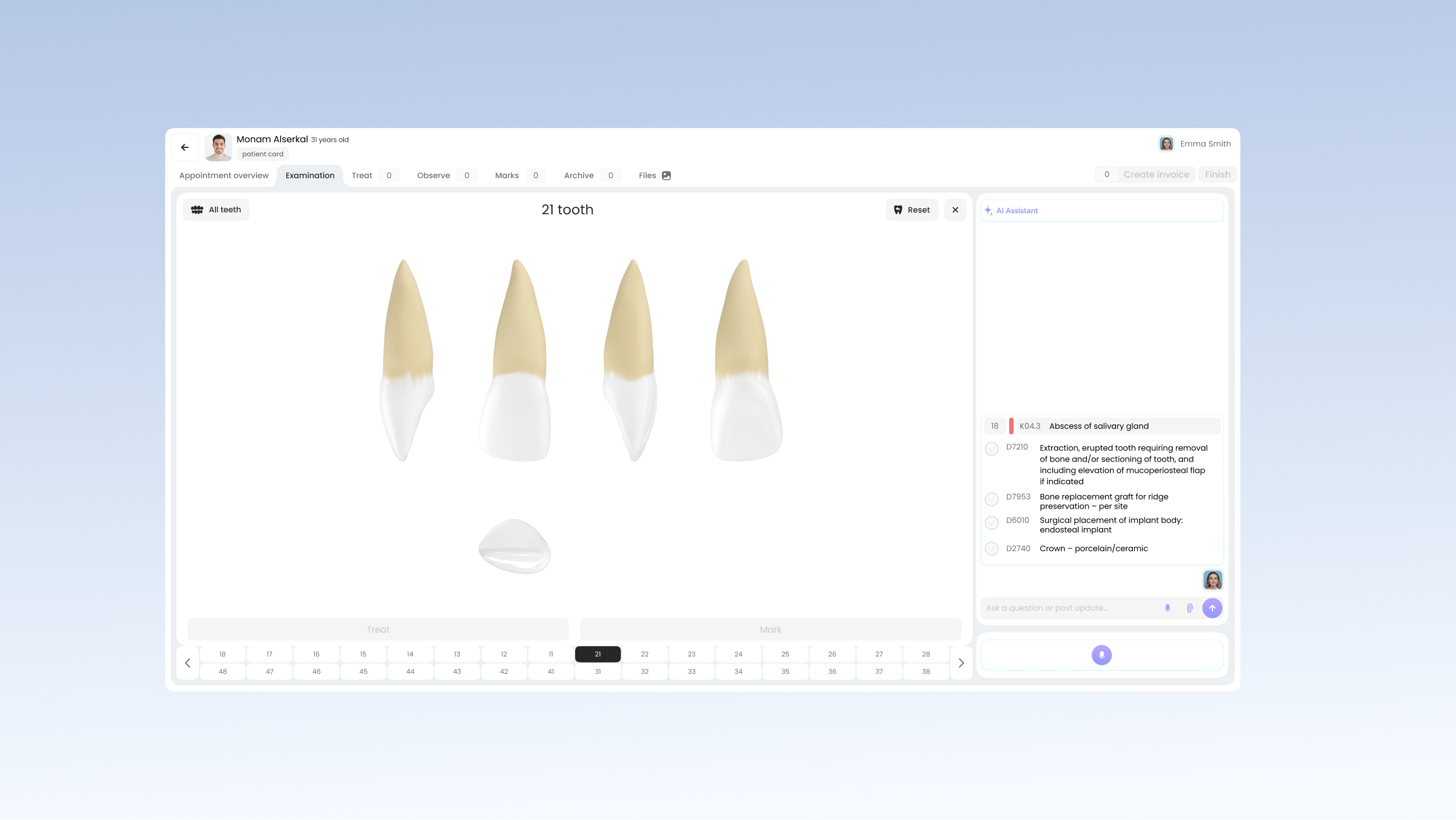
Dental Chart
SVG tooth map. Diagnoses attached to surfaces and anatomy.
Treatment plans
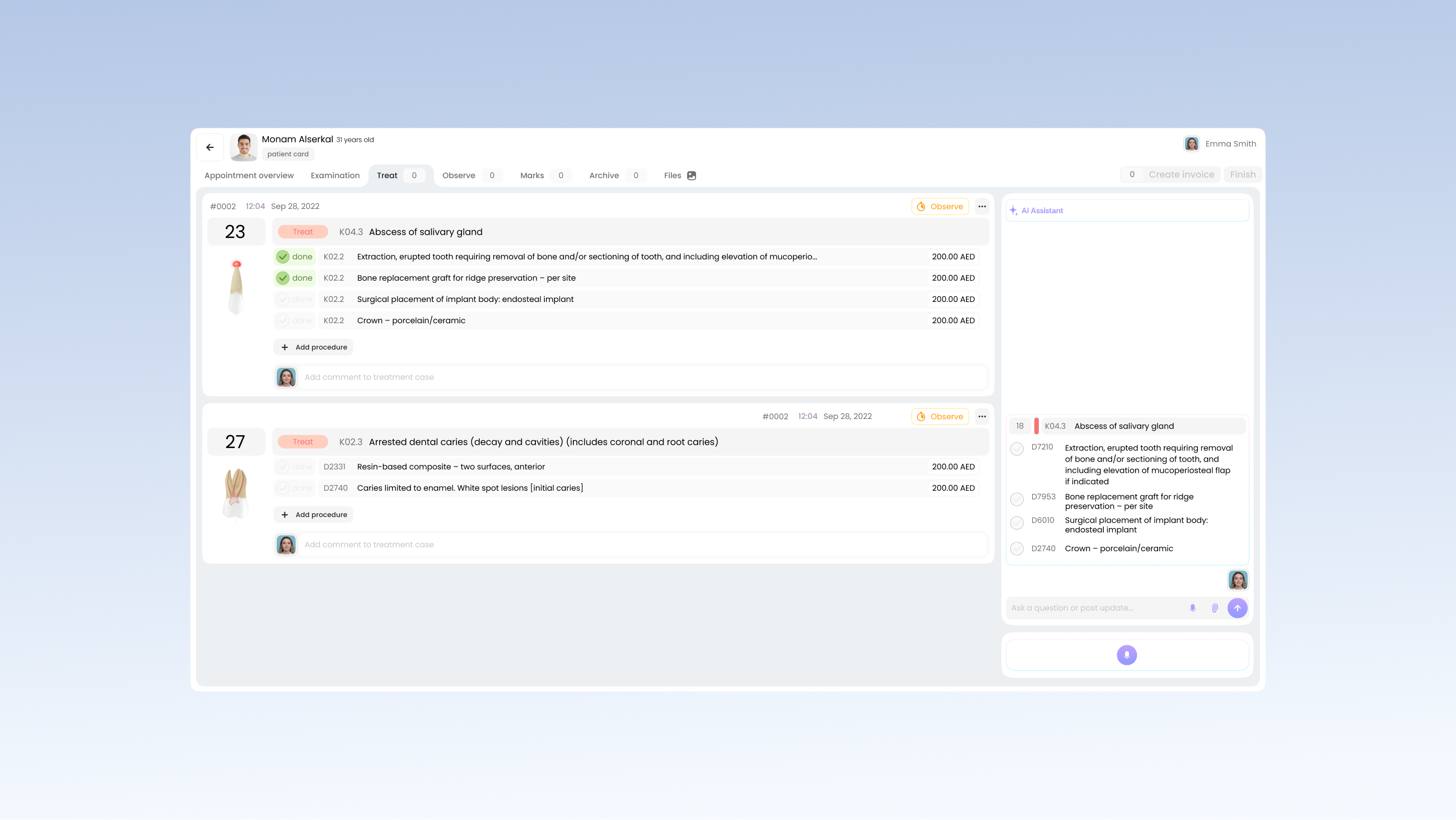
Treatment planning connects clinical decisions with real-world execution.
Treatment plans are one of the most complex parts of a dental EMR. A plan can include diagnoses, procedures, phases, notes, healing periods, costs, and follow-up bookings.
I designed workflows that help doctors structure treatment step by step, while allowing clinic teams to convert treatment phases into scheduled appointments.
This turns the treatment plan from a static document into an operational workflow between doctor, patient, front desk, and calendar.
AI voice diagnosis
Voice input turns clinical speech into structured chart data.
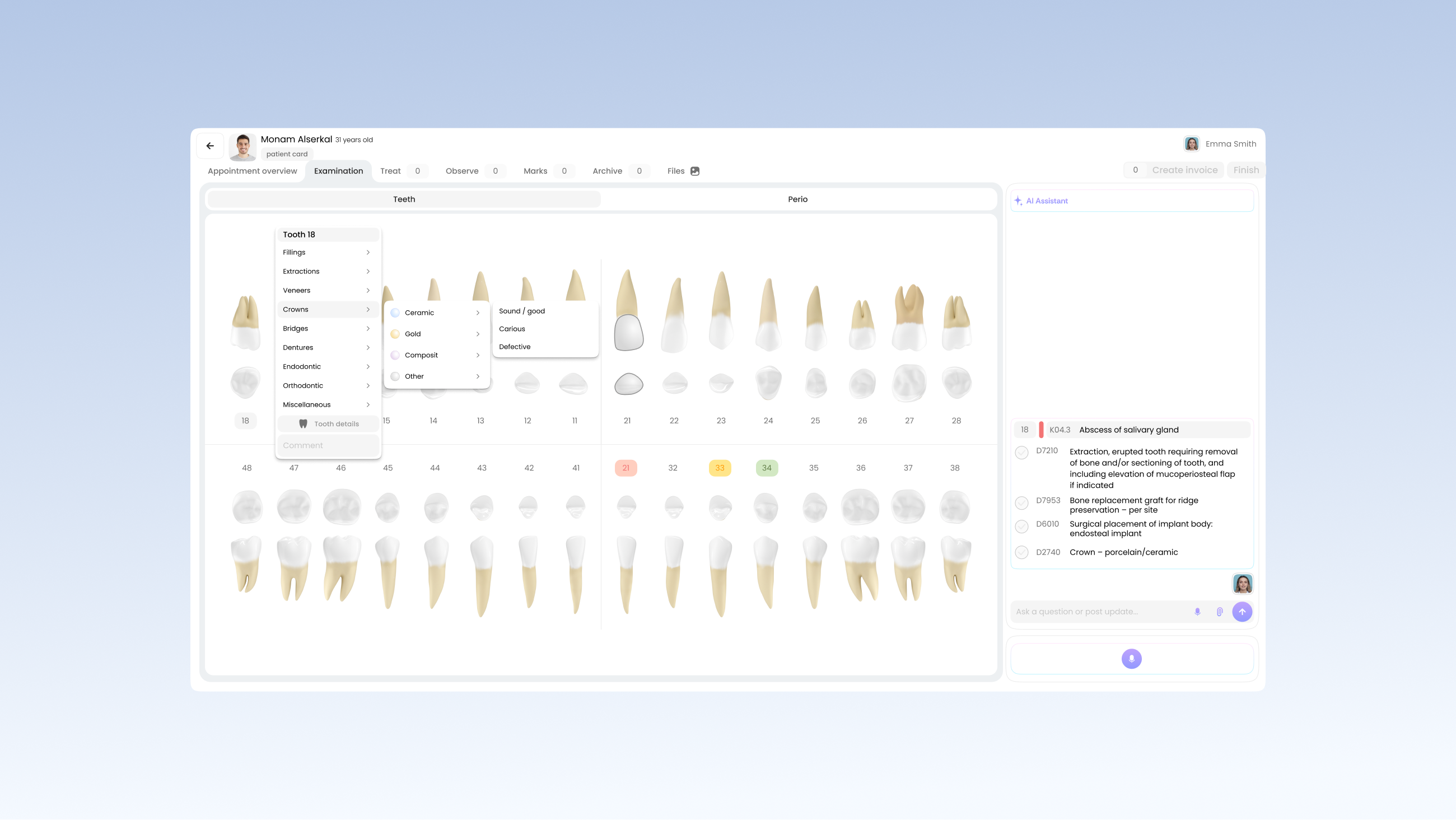
I designed AI-assisted flows where a doctor can dictate a diagnosis and pin it directly to a specific tooth on the chart. The goal is to reduce manual input while keeping the clinician in control.
This required interaction patterns for voice capture, transcript review, tooth selection, AI interpretation, and structured confirmation.
Communication hub
Automating patient communication across WhatsApp, SMS, and email.
I designed a trigger-based communication system that helps clinics send confirmations, reminders, follow-ups, and transactional messages based on events inside Remedico.
◳ Image to prepare
Enterprise automation dashboard for dental clinic patient communication. Visual workflow builder with trigger nodes, WhatsApp, SMS, and email channels, message templates with variables, appointment confirmation status, delivery analytics. Dark graphite background, mint connection lines, floating cards, premium SaaS operations center aesthetic, no real brand logos or patient data.
Brand system
Building the visual language from zero.
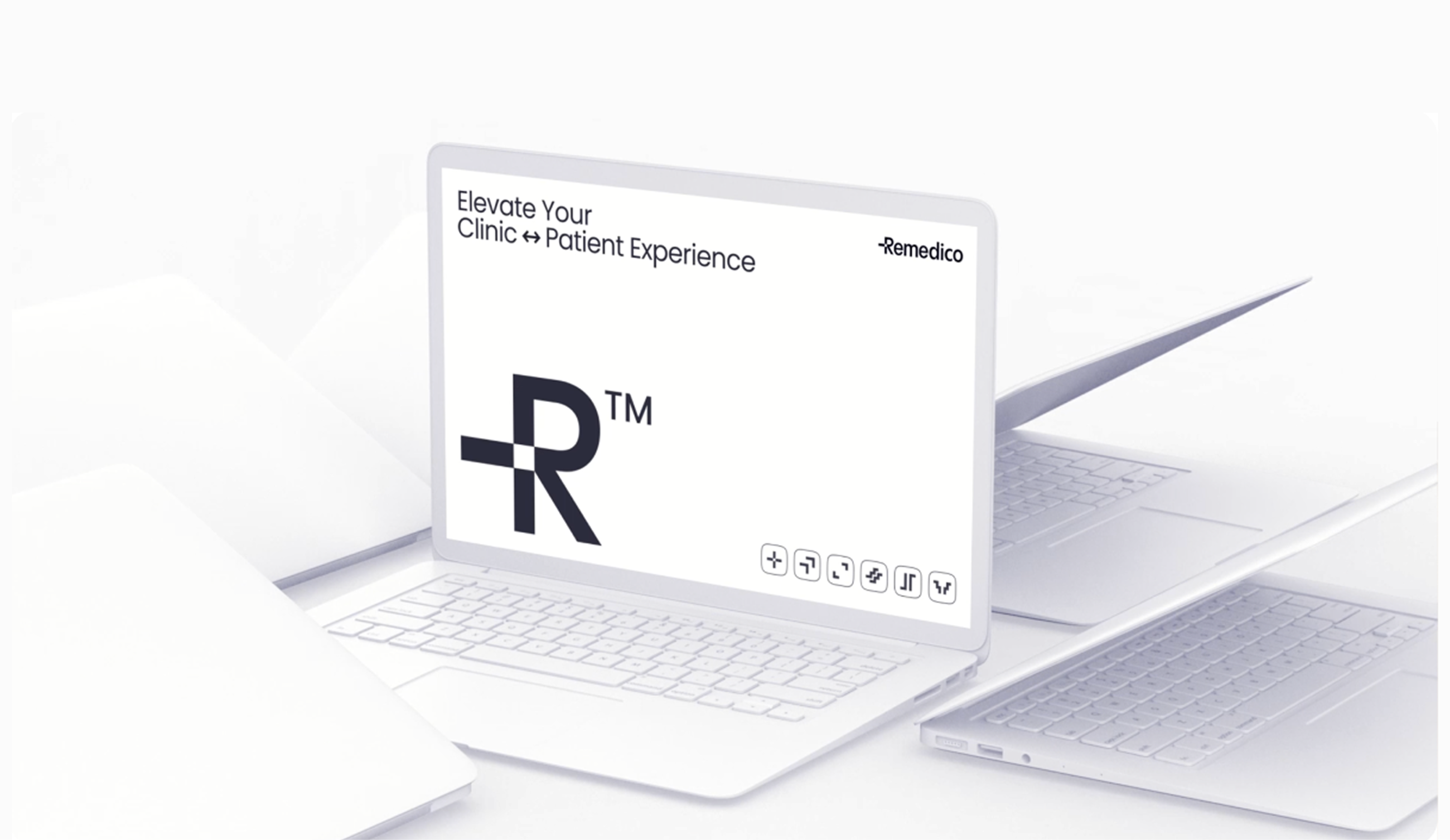
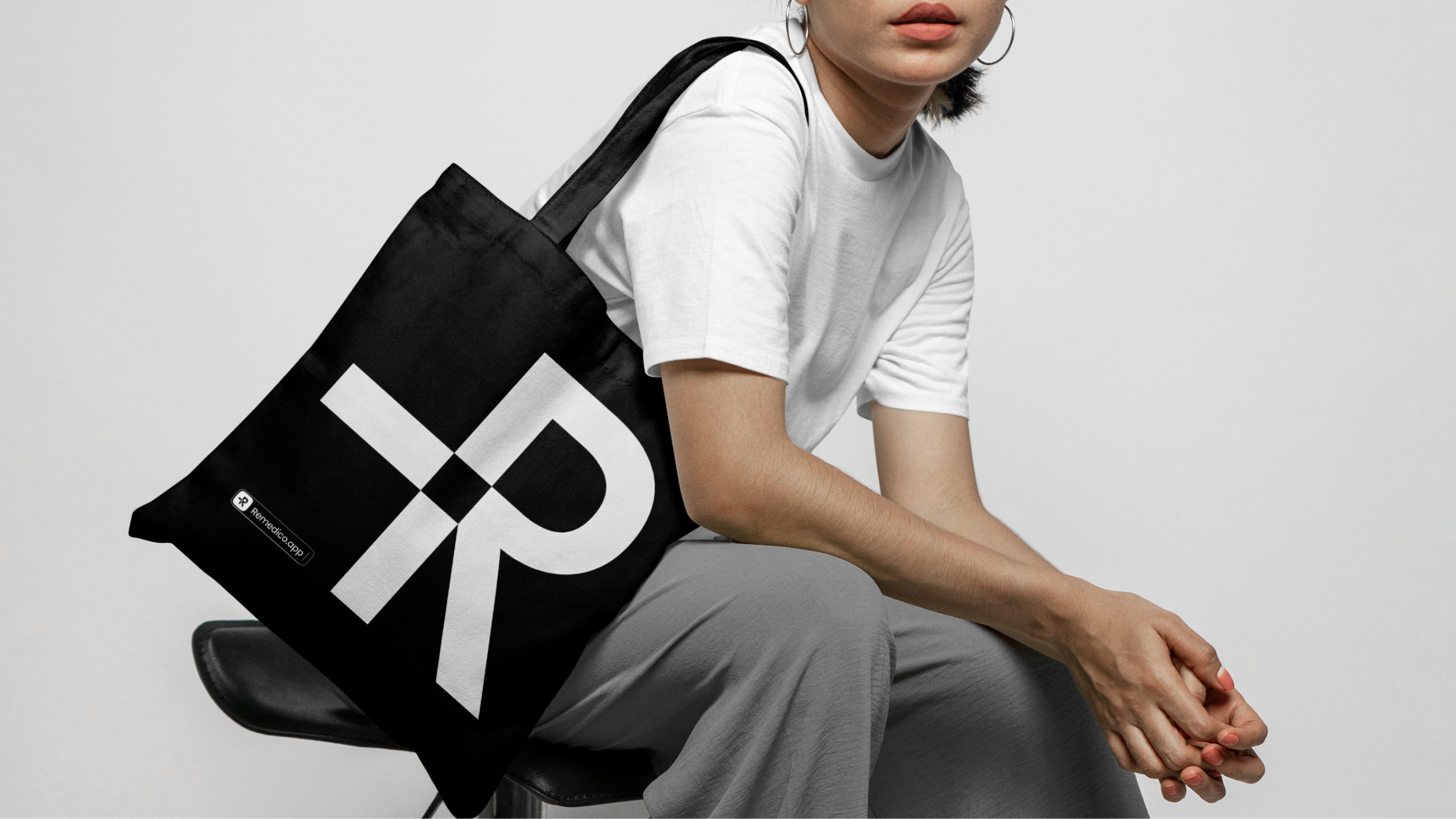
As founding designer, I created the Remedico brand identity and visual system from scratch. The brand had to feel clinical, trustworthy, modern, and approachable — serious enough for healthcare, but not cold or bureaucratic.
The design language evolved into a clean SaaS system with soft medical tones, calm surfaces, rounded interfaces, and a visual direction that could extend across product, website, sales materials, exhibitions, and AI features.
Marketing website
The landing page had to translate a complex clinic system into a simple product story.
I designed the Remedico marketing site to communicate trust, clarity, and product value to clinic owners and decision-makers. The website became the bridge between a complex EMR product and a clear sales narrative.
Real-world validation
Presented at AEEDC Dubai and tested against real clinic workflows.
I personally presented Remedico at AEEDC Dubai in 2023 and 2025. This gave me direct exposure to clinic owners, dentists, and operational teams — the people who would actually rely on the system.
That feedback loop shaped how I approached complexity: every feature had to survive the reality of a working clinic, not just look polished in Figma.
◳ Image to prepare
Cinematic exhibition booth scene for healthcare SaaS at a dental conference in Dubai. Premium booth with large screens showing a SaaS dashboard, visitors interacting, soft spotlights, graphite and mint brand colors, modern medical tech atmosphere, realistic photography style, no identifiable faces, no readable private data.
Dentaverse
Extending Remedico into immersive patient education.
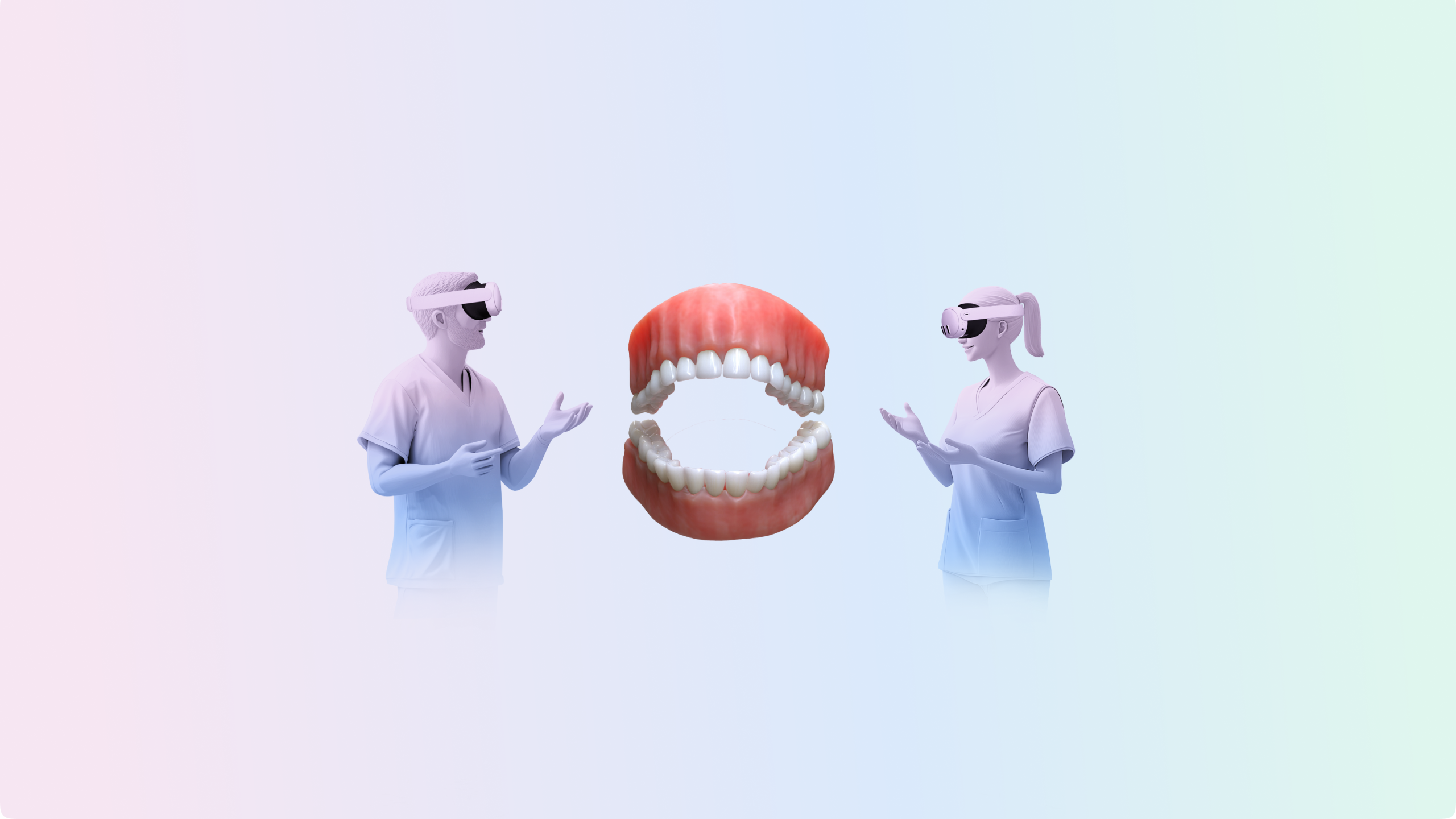
Alongside the main EMR, I collaborated on Dentaverse — a Meta Quest VR experience that lets dentists walk patients through complex treatments using a life-size 3D jaw.
The project pushed the Remedico ecosystem beyond clinic management into treatment visualization and patient understanding.
Behind the scenes
The best decisions rarely happened inside Figma.
My process included stakeholder interviews, workflow analysis with clinic staff, workshops with clinicians, user journey mapping, rapid prototyping, and continuous feedback loops between design and engineering.
The hardest part was always balancing three constraints at once: clinical accuracy, business goals, and technical reality. Sometimes the best feature was removing three existing ones.
Tools & workflow
Design
Figma
FigJam
Framer
Research
Hotjar
Google Analytics
User interviews
AI & automation
Claude
Cursor
ChatGPT
Delivery
HTML / CSS
Design tokens
Git workflow
Claude Code
Evolution of my role
From handing off Figma files to shipping production code.
Remedico is where I grew from a designer handing off mockups into a designer working design-to-production. In many flows I completed up to 90% of the front-end before engineering handoff.
This collapsed the gap between idea and production and made design part of delivery, not a step before it.
↳ Local dev environments
↳ AI-assisted workflows
↳ Working directly in the codebase
↳ HTML / CSS / front-end contributions
↳ Shipping production-ready components via Figma → Pencil → Cursor → Claude Code
Outcome
In healthcare, good design is measured not only by beautiful screens, but by the mistakes that never happen.
Lessons learned
Remedico taught me to design systems, not screens.
Systems where UX quality directly affects the quality of care.
And that's exactly the kind of complexity that keeps me excited about design.